
C. V. Raman Sanatan Olympiad
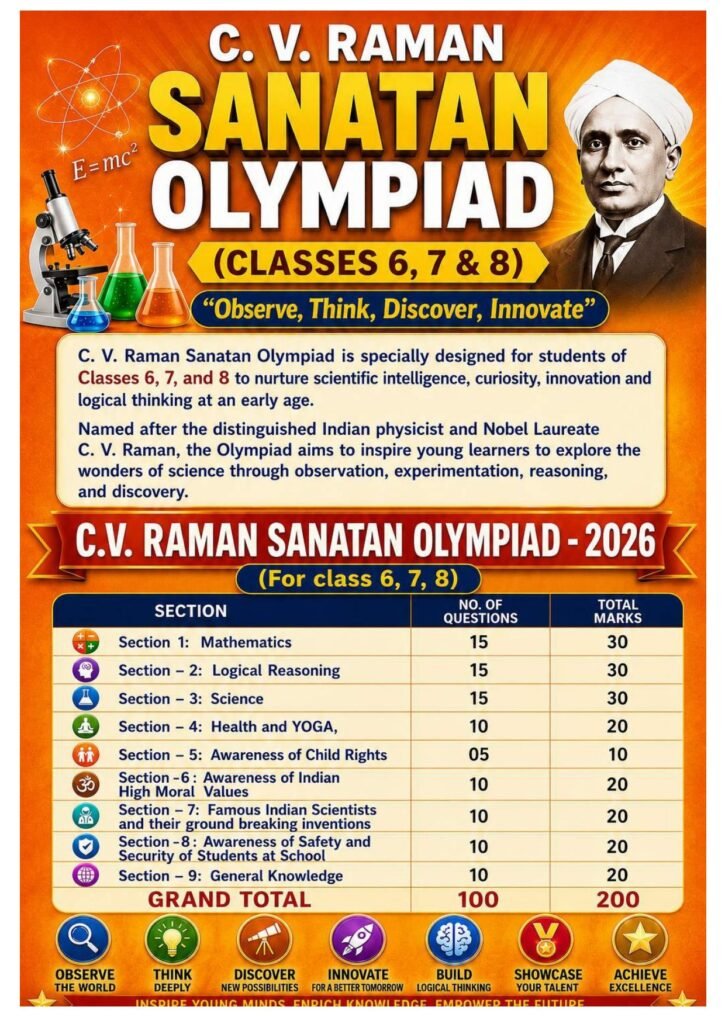
“Observe, Think, Discover, Innovate”
C. V. Raman Sanatan Olympiad is specially designed for students of Classes 6, 7, and 8 to nurture scientific intelligence, curiosity, innovation and logical thinking at an early age. Named after the distinguished Indian physicist and Nobel Laureate C. V. Raman, the Olympiad aims to inspire young learners to explore the wonders of science through observation, experimentation, reasoning, and discovery.
This stage of the Sanatan Olympiad encourages students to develop a scientific temperament, analytical skills, problem-solving abilities and a spirit of inquiry. It helps participants understand scientific concepts in a practical and engaging manner while strengthening their foundation in Science, Mathematics, Environmental Studies, and General Knowledge.
The Olympiad promotes creativity, innovation, and critical thinking, enabling students to connect classroom learning with real-life applications. Along with scientific excellence, it also emphasizes ethical values, discipline, and responsible use of knowledge for the welfare of society.
By encouraging young minds to question, investigate, and innovate, the C. V. Raman Sanatan Olympiad prepares students to become future scientists, researchers, innovators and responsible citizens who can contribute meaningfully to national development and global progress.
SYLLABUS : C.V. RAMAN SANATAN OLYMPAID – 2026
Class – 6
Section -1 : Mathematics :-
Knowing our Numbers, Whole Numbers, Playing with Numbers, Basic Geometrical Ideas, Understanding Elementary Shapes, Integers, Fractions, Decimals, Data Handling, Mensuration, Algebra, Ratio and Proportion, Symmetry.
Section -2 : Logical Reasoning :-
Analogy, Series, Coding-decoding, Alphabet test, Mirror image, Paper folding, Opened out, Odd one out, Mathematical reasoning, Analytical reasoning, Puzzle test. Skills like conscious application in real life, Logical & Inductive Reasoning, Tactics & Strategies in decision making.
Section – 3 Science:-
Heat, Motion and Time, Electric Current and its Effects, Winds, Storms and Cyclones, Light, Acids, Bases and Salts, Physical and Chemical Changes, Weather, Climate and Adaptations of Animals to Climate, Fiber to Fabric, Nutrition in Plants and Animals, Respiration in Organisms, Transportation in Plants and Animals, Reproduction in Plants, Natural Resources and Their Conservation (Soil, Water: A Precious Resource, Forests our Lifeline, Wastewater Story).
Section -4 : Health and Yoga :-
Basic introduction to yoga concepts like Yama (Ethical Principal), Niyama (personal discipline), Simple Asanas like Tadasan (mountain pose), Sukhasana (Easy pose), and basic Breathing exercise (Pranayam). Health and hygiene at school level, preventive steps for contanigious diseases like –
Section – 5 : Awareness of Child Rights, POSCO Act, Child Abuse, Drug Abuse substance and Prevention :-
Concepts of Child Rights in India, Ancient and modern practices for securing child rights in India. Social and legal aspects of child rights. Ten fundamental child rights in India – 1- Right to Survival : Ensuring a Strong Start. 2- Right to Education : Nurturing Young Minds. 3- Right to Protection : Safeguarding Innocence. 4- Right to Participation : Empowering young Voices. 5- Right to Development : Nurturing Holistic Growth. 6- Right to Health and Well-Being : Building a Healthy Future. 7- Right to Identity : Recognizing Individuality. 8- Right to Expression : Fostering Creativity. 9-Right Against Discrimination : Promoting Equality. 10- Right to a Safe Environment : Preserving Tomorrow’s world.
Section – 6 : Awareness of High Moral Values :-
Importance of national integrity, basic concept of Akhand Bharat, contribution of freedom fighters. Ethical values like – Respect, Honesty, Responsibility,Hard Work, Kindness, Co-operation etc.
Section – 7 : Famous Indian Scientists and their ground breaking inventions :-
Aryabhatta, Bhaskarachaary-II, Charak, Sushurta, Kanad, Nagarjuna, Bhrahmagupta, Varahmihira, Chanakya, Patanjali, C.V. Raman, Homi. J. Bhabha, Satyendra Nath Bose, Vikram Ambalal Sarabhai, A.P.J. Abdul Kalam, Srinivas Ramanujam, Meghnad Saha, Birbal Sahani, M. Vishvesaraiya etc.
Section – 8 : Awareness of Safety and Security of Students at School :-
School safety Rules : Role and importance of students in implementation of National School safety Policy- 2016. Safety Rules for Disaster like – Earth Quake, Flood, Fire. Awareness about safety measures for Fire. Understanding the concept of Child friendly school campus.
Section – 9 : General Knowledge :-
Indian History : Ancient Science and Technology, Ancient Culture, Vedic Period, Post- Vedic Period. Important books of Sanskrit and Hindi literature. Important learning of Great Holy books – The Ramayan, The Bhagwad Gita, Indian Geography, Sports, Arts and Culture. Folk Songs and Folk Dances, Important festivals of India. The learning from Greatest Indian warriors like – Veer Hanuman, Veer Abhimanyu, Chandragupta Mourya, Ashoka The Great, Veer Shiromani Maharana Pratap, Rani Laxmi Bai, Chhatrapati Shivaji Maharaj, Guru Govind Singh.
Class – 7
Section -1 : Mathematics, Vedic Mathematics :-
Number System, Integers, Rational Numbers, Fractions and Decimals, Data Handling, Simple Equations, Lines and Angles, Triangle and its Properties, Congruence of Triangles, Comparing Quantities, Practical Geometry, Perimeter and Area, Algebraic Expressions, Exponents and Powers, Symmetry. Statistics, Quadrilaterals, Circles, Mensuration.
Section -2 : Logical Reasoning :-
Reasoning : Analogy, Series, Coding-Decoding, Alphabet test, Mirror Image, Folded in, Paper cutting, Odd one out, Analytical Reasoning, Direction sense test, Mathematical Reasoning, Puzzle test. Higher order thinking questions includes a combination of skills like conscious application in real life, Logical & Inductive Reasoning, Tactics & Strategies in decision making.
Section – 3 Science:-
Heat, Motion and Time, Electric Current and its Effects, Winds, Storms and Cyclones, Light, Acids, Bases and Salts, Physical and Chemical Changes, Weather, Climate and Adaptations of Animals to Climate, Fiber to Fabric, Nutrition in Plants and Animals, Respiration in Organisms, Transportation in Plants and Animals, Reproduction in Plants, Natural Resources and Their Conservation (Soil, Water: A Precious Resource, Forests our Lifeline, Wastewater Story). Food and Diseases, Preventive methods to Contanigious Diseases.
Section – 4 : Health and Yoga, Mental Health :-
Basic introduction to yoga concepts like Yama (Ethical Principal), Niyama (personal discipline), Simple Asanas like Tadasan (mountain pose), Sukhasana (Easy pose), and basic brathing exercise (Pranayama). Health and hygine at school level, preventive steps for contanigious diseases like –
Section – 5 : Awareness of Child Rights, POSCO Act, Child Abuse, Drug Abuse substance and Prevention :-
Concepts of Child Rights in India, Ancient and modern practices for securing child rights in India. Social and legal aspects of child rights. Ten fundamental child rights in India – 1- Right to Survival : Ensuring a Strong Start. 2- Right to Education : Nurturing Young Minds. 3- Right to Protection : Safeguarding Innocence. 4- Right to Participation : Empowering young Voices. 5- Right to Development : Nurturing Holistic Growth. 6- Right to Health and Well-Being : Building a Healthy Future. 7- Right to Identity : Recognizing Individuality. 8- Right to Expression : Fostering Creativity. 9-Right Against Discrimination : Promoting Equality. 10- Right to a Safe Environment : Preserving Tomorrow’s world.
Section – 6 : Awareness of High Moral Values :-
Importance of National Integrity, Basic Concept of Akhand Bharat, Contribution of Freedom fighters. Ethical values like – Respect, Honesty, Responsibility, Hard Work, Kindness, Co-operation etc.
Section – 7 : Famous Indian Scientists and their ground breaking inventions :-
Aryabhatta, Bhaskarachaary-II, Charak, Sushurta, Kanad, Nagarjuna, Bhrahmagupta, Varahmihira, Chanakya, Patanjali, C.V. Raman, Homi. J. Bhabha, Satyendra Nath Bose, Vikram Ambalal Sarabhai, A.P.J. Abdul Kalam, Srinivas Ramanujam, Meghnad Saha, Birbal Sahani, M. Vishvesaraiya etc.
Section – 8 : Awareness of Safety and Security of Students at School :-
School safety Rules : Role and Importance of students in implementation of National School Safety Policy- 2016. Safety Rules for Disaster like – Earth Quake, Flood, Fire. Awareness about Safety measures for Fire. Understanding the concept of Child friendly school campus.
Section – 9 : General Knowledge :-
Indian History : Ancient Science and Technology, Ancient Culture, Vedic Period, Post- Vedic Period. Important books of Sanskrit and Hindi literature. Important learning of Great Holy books – The Ramayan, The Bhagwad Gita, Indian Geography, Sports, Arts and Culture. Folk Songs and Folk Dances, Important Festivals of India. The learning from greatest Indian warriors like – Veer Hanuman, Veer Abhimanyu, Chandragupta Mourya, Ashoka The Great, Veer Shiromani Maharana Pratap, Rani Laxmi Bai, Chhatrapati Shivaji Maharaj. Guru Govind Singh.
Class – 8
Section -1 : Mathematics :-
Rational Numbers, Linear Equations in One Variable, Understanding Quadrilaterals, Data Handling, Squares and Square Roots, Cubes and Cube Roots, Comparing Quantities, Algebraic Expressions and Identities, Visualizing Solid Shapes, Mensuration, Exponents and Powers, Direct and Inverse Proportions, Factorization.
Section -2 : Logical Reasoning :-
Analogy, Series, Coding-decoding, Mirror image, Paper cutting, Odd one out, Analytical reasoning, Direction sense, Mathematical reasoning, Cube and dice, Clocks, Calendar, Logical venn diagrams. Questions includes a combination of skills like conscious application in real life, Logical & Inductive Reasoning, Tactics & Strategies in decision making, higher order thinking.
Section – 3 Science:-
Crop Production and Management, Microorganisms, Synthetic Fibres and Plastics, Metals and Non-metals, Coal and Petroleum, Combustion and Flame, Conservation of Plants and Animals, Cell, Reproduction and Endocrine System, Force and Pressure, Friction, Sound, Chemical Effects of Electric Current, Some Natural Phenomena, Light, Stars and the Solar System, Pollution of Air and Water.
Section – 4 : Health and Yoga :-
Basic introduction to yoga concepts like Yama (Ethical Principal), Niyama (personal discipline), Simple Asanas like Tadasan (mountain pose), Sukhasana (Easy pose), and basic brathing exercise (Pranayama). Health and hygine at school level, preventive steps for contanigious diseases like –
Section – 5 : Awareness of Child Rights, POSCO Act, Child Abuse, Drug Abuse substance and Prevention :-
Concepts of Child Rights in India, Ancient and modern practices for securing child rights in India. Social and legal aspects of child rights. Ten fundamental child rights in India – 1- Right to Survival : Ensuring a Strong Start. 2- Right to Education : Nurturing Young Minds. 3- Right to Protection : Safeguarding Innocence. 4- Right to Participation : Empowering young Voices. 5- Right to Development : Nurturing Holistic Growth. 6- Right to Health and Well-Being : Building a Healthy Future. 7- Right to Identity : Recognizing Individuality. 8- Right to Expression : Fostering Creativity. 9-Right Against Discrimination : Promoting Equality. 10- Right to a Safe Environment : Preserving Tomorrow’s world.
Section – 6 : Awareness of High Moral Values :-
Importance of National Integrity, Basic Concept of Akhand Bharat, Contribution of Freedom Fighters. Ethical values like – Respect, Honesty, Responsibility, Hardwork, Kindness, Co-operation etc.
Section – 7 : Famous Indian Scientists and their ground breaking inventions :-
Aryabhatta, Bhaskarachaary-II, Charak, Sushurta, Kanad, Nagarjuna, Bhrahmagupta, Varahmihira, Chanakya, Patanjali, C.V. Raman, Homi. J. Bhabha, Satyendra Nath Bose, Vikram Ambalal Sarabhai, A.P.J. Abdul Kalam, Srinivas Ramanujam, Meghnaad Saha, Birbal Sahani, M. Vishvesaraiya etc.
Section – 8 : Awareness of Safety and Security of Students at School :-
School safety Rules : Role and Importance of students in implementation of National School Safety Policy- 2016. Safety Rules for Disaster like – Earth Quake, Flood, Fire. Awareness about safety measures for Fire. Understanding the concept of child friendly school campus.
Section – 9 : General Knowledge :-
Indian History : Ancient Science and Technology, Ancient Culture, Vedic Period, Post- Vedic Period. Important books of Sanskrit and Hindi literature. Important learning of Great Holy books – The Ramayan, The Bhagwad Gita, Indian geography, Sports, Arts and Culture. Folk songs and Folk Dances, Important festivals of India. The learning from greatest Indian warriors like – Veer Hanuman, Veer Abhimanyu, Chandragupta Mourya, Ashoka The Great, Veer Shiromani Maharana Pratap, Rani Laxmi Bai, Chhatrapati Shivaji Maharaj. Guru Govind Singh, The Major Contributions to Indian Culture by Poet like – Tulsidas, Surdas, Mirabai.