
Srinivasa Ramanujan Sanatan Olympiad
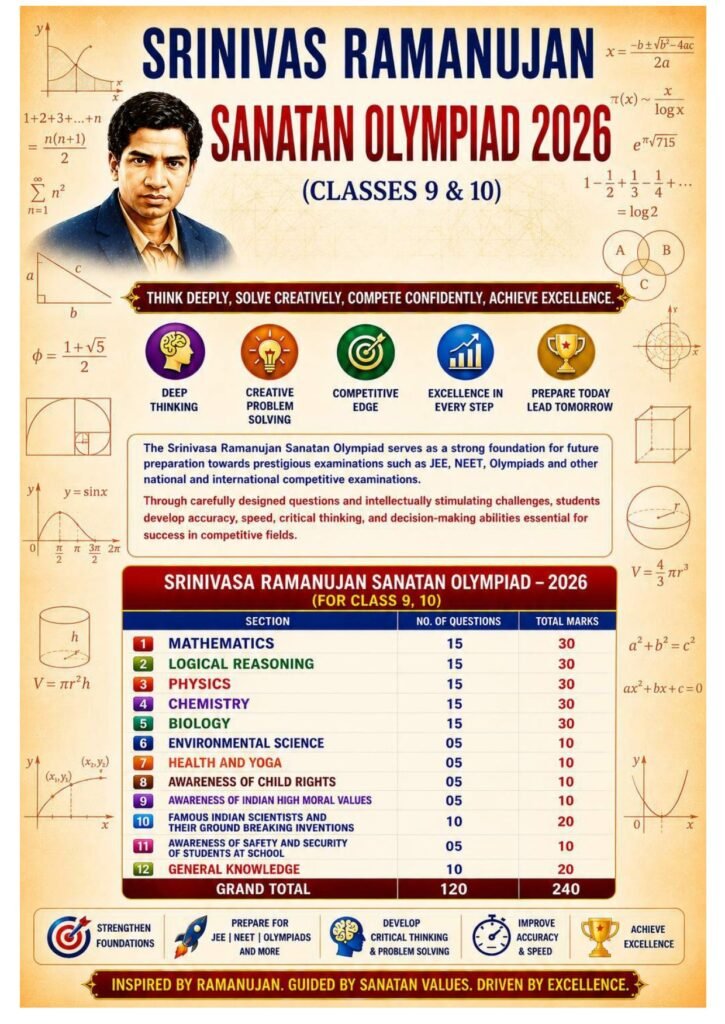
Srinivasa Ramanujan Sanatan Olympiad
“Think Deeply, Solve Creatively, Compete Confidently, Achieve Excellence.”
Srinivasa Ramanujan Sanatan Olympiad is a prestigious academic platform designed for students of Classes 9 and 10 to cultivate scientific intelligence, mathematical excellence, innovative thinking, and a strong competitive spirit. Inspired by the extraordinary genius of Srinivasa Ramanujan, this Olympiad seeks to identify and nurture young talent capable of achieving excellence in higher education and national-level competitive examinations.
At this crucial stage of learning, the Olympiad focuses on strengthening conceptual understanding, analytical reasoning, problem-solving skills, logical aptitude, and scientific temperament. It encourages students to think beyond textbooks, explore innovative solutions, and develop the confidence required to excel in challenging academic environments.
The Srinivasa Ramanujan Sanatan Olympiad serves as a strong foundation for future preparation towards prestigious examinations such as JEE, NEET, Olympiads and other national and international competitive examinations. Through carefully designed questions and intellectually stimulating challenges, students develop accuracy, speed, critical thinking, and decision-making abilities essential for success in competitive fields.
Beyond academic achievement, the Olympiad inspires students to embrace discipline, perseverance, creativity and lifelong learning. It nurtures future scientists, engineers, medical professionals, researchers, innovators, and leaders who can contribute significantly to the advancement of society and the nation.
The Srinivasa Ramanujan Sanatan Olympiad is not merely a competition—it is a journey towards intellectual excellence, scientific innovation, and competitive readiness.
SYLLABUS:
SRINIVAS RAMANUJAM SANATAN OLYMPIAD – 2026
Class – 9
Section -1 : Mathematics :-
Number Systems, Square and Cube roots, playing with numbers, rational numbers, Arithmetic, Arithmetic Progressions, Direct & Inverse Variations, Exponents, Polynomials, Linear Equations in Two Variables, Quadratic equations, Trigonometry Introduction to Euclid’s Geometry, Lines and Angles, Triangles, Quadrilaterals, Areas of Parallelograms and Triangles. Circles, Heron’s Formula, Surface Areas and Volumes. Statistics, Mensuration, Surface Area and Volume.
Section -2 : Logical Reasoning :-
Analogy, Series Completion, Classification, Coding and Decoding, Mirror and Water Image, Blood Relations, Odd one Out, Analytical Reasoning, Direction Sense Test, Mathematical Reasoning, Cube and Dice, Dot Representation. Statement –Assumptions.
Section – 3 Physics :-
Motion, Force and Laws of Motion, Gravitation, Floatation, Work and Energy and Power, Sound, Matter in our surroundings,
Section – 4 Chemistry :-
Matter in our surroundings, Physical and Chemical properties of matter, Elements, Compounds, Mixtures, Solution, Suspension and Colloids, Physical and Chemical Changes, Atoms and Molecules, Structure of Atoms – Electrons, Protons, Neutrons, Atomic Number, Mass Number, Distributions of Electrons in various Orbit, Isotopes and Isobars. Law of Chemical Combination, Atomic Mass, Molecules, Molecular Mass. Ion, Valancy. Name and Formulae of Ionic Compounds, the Mole Concept, Percentage Composition,
Section – 5 Biology :-
The Fundamental Unit of Life, Cell : Shapes and Sizes, Structure of a Cell. Tissues, Plant Tissues, Diversity in Living Organisms, Evaluation and Development of Organism, Kingdom Morena, Kingdom Fungi, Kingdom Animalia, Nomenclature. Why Do We Fall ill ? Diseases and their causes, Spread of Infectious Diseases. Principal of Treatment. Some Microbial Diseases. Natural Resources, Improvement in Food Resources.
Section – 6 Environmental Science :-
Concept of Sustainable Development, Natural Resources, like water, solar energy, Types of Soil, soil pollution, wildlife, forests, minerals, mountains. Renewable Resources, Non Renewable Resources, Atmosphere, Climate, Pollution – Air Pollution, Water Pollution, Green House Effect Plantation.
Section – 7 : Health and Yoga :-
Basic introduction to yoga concepts like Yama (Ethical Principal), Niyama (personal discipline), Simple Asanas like Tadasan (mountain pose), Sukhasana (Easy pose), and basic brathing exercise (Pranayama). Health and hygine at school level, preventive steps for contanigious diseases like –
Section – 8 : Awareness of Child Rights, POSCO Act, Child Abuse, Drug Abuse substance and Prevention :-
Concepts of Child Rights in India, Ancient and modern practices for securing child rights in India. Social and legal aspects of child rights. Ten fundamental child rights in India – 1- Right to Survival : Ensuring a Strong Start. 2- Right to Education : Nurturing Young Minds. 3- Right to Protection : Safeguarding Innocence. 4- Right to Participation : Empowering young Voices. 5- Right to Development : Nurturing Holistic Growth. 6- Right to Health and Well-Being : Building a Healthy Future. 7- Right to Identity : Recognizing Individuality. 8- Right to Expression : Fostering Creativity. 9-Right Against Discrimination : Promoting Equality. 10- Right to a Safe Environment : Preserving Tomorrow’s world.
Section – 9 : Awareness of High Moral Values :-
Importance of National Integrity, Basic Concept of Akhand Bharat, Contribution of Freedom Fighters. Ethical values like – Respect, Honesty, Responsibility, Hardwork, Kindness, Co-operation etc.
Section – 10 : Famous Indian Scientists and their ground breaking inventions :-
Aryabhatta, Bhaskarachaary-II, Charak, Sushurta, Kanad, Nagarjuna, Bhrahmagupta, Varahmihira, Chanakya, Patanjali, C.V. Raman, Homi. J. Bhabha, Satyendra Nath Bose, Vikram Ambalal Sarabhai, A.P.J. Abdul Kalam, Srinivas Ramanujam, Meghnad Saha, Birbal Sahani, M. Vishvesaraiya etc.
Section – 11 : Awareness of Safety and Security of Students at School :-
School Safety Rules : Role and Importance of students in implementation of National School Safety Policy- 2016. Safety Rules for Disaster like – Earth Quake, Flood, Fire. Awareness about Safety measures for Fire. Understanding the concept of child friendly school campus.
Section – 12 : General Knowledge :-
Indian History : Ancient Science and Technology, Ancient Culture, Vedic Period, Post- Vedic Period. Important books of Sanskrit and Hindi literature. Important learning of Great Holy books – The Ramayan, The Bhagwad Gita, Indian geography, Sports, Arts and Culture. Folk songs and Folk Dances, Important festivals of India. The learning from greatest Indian warriors like – Veer Hanuman, Veer Abhimanyu, Chandragupta Mourya, Ashoka The Great, Veer Shiromani Maharana Pratap, Rani Laxmi Bai, Chhatrapati Shivaji Maharaj, . Guru Govind Singh. The teachings of Guru Nanak, Gautam Buddha, Mahavir etc. Vasudhaiv Kutubkam : the Great concept to unite the human kind.
Class – 10
Section -1 : Mathematics :-
Number System, Polynomials and Rational Expressions, Pair of Linear Equations in Two Variables, Quadratic Equations and Inequalities, Sets Relation and Functions, Progressions, Triangles, Circles, Mensuration, Geometry, Coordinate Geometry, Probability, Introduction to Trigonometry, Some Applications of Trigonometry,
Section -2 : Logical Reasoning :-
Analogy, Series, Coding and decoding, Alphabet test, Mirror and water image, Blood relations, Odd one out, Analytical reasoning, Direction sense test, Mathematical reasoning, Cube and Dice, Puzzle test, Venn diagram, Comprehension analysis. Higher order thinking questions includes a combination of skills like conscious application in real life, Logical & Inductive Reasoning, Tactics & Strategies in decision making.
Section – 3 Physics :-
Motion, Force and Laws of Motion, Gravitation, Floatation, Work and Energy and Power, Sound, Matter in our surroundings,
Section – 4 Chemistry :-
Matter in our surroundings, Physical and Chemical properties of matter, Elements, Compounds, Mixtures, Solution, Suspension and Colloids, Physical and Chemical Changes, Atoms and Molecules, Structure of Atoms – Electrons, Protons, Neutrons, Atomic Number, Mass Number, Distributions of Electrons in various Orbit, Isotopes and Isobars. Law of Chemical Combination, Atomic Mass, Molecules, Molecular Mass. Ion, Valancy. Name and Formulae of Ionic Compounds, the Mole Concept, Percentage Composition,
Section – 5 Biology :-
The Fundamental Unit of Life, Cell : Shapes and Sizes, Structure of a Cell. Tissues, Plant Tissues, Diversity in Living Organisms, Evaluation and Development of Organism, Kingdom Morena, Kingdom Fungi, Kingdom Animalia, Nomenclature. Why Do We Fall ill ? Diseases and their causes, Spread of Infectious Diseases. Principal of Treatment. Some Microbial Diseases. Natural Resources, Improvement in Food Resources.
Section – 6 Environmental Science :- Definition of environment and its components (biotic and abiotic), Ecosystem – structure and functions, Food Chain and Food Web, Biodiversity – types and importance, Renewable and non-renewable resources ,Water resources – conservation and management, Forest resources – importance and conservation, Mineral and energy resources, Sustainable Development , Air pollution – causes, effects, and control, Water pollution – sources and prevention, Soil pollution Noise pollution, Plastic and e-waste pollution, Causes of climate change, Greenhouse Effect, Impacts of global warming, Biodiversity hotspots, Endangered species, Wildlife conservation, National parks and wildlife sanctuaries, Population, growth and environment, Urbanization and industrialization, Environmental ethics, Lifestyle and environment (eco-friendly lifestyle), Environment Protection Act, 1986, Wildlife Protection Act, 1972, Water and Air Acts, Swachh Bharat Mission, National Green Tribunal (NGT), Natural disasters – floods, earthquakes, cyclones, Man-made disasters, Disaster management strategies, Climate-related disasters, Green technology, Renewable energy (solar, wind, biogas), Waste management, 3R principle – Reduce, Reuse, Recycle, International environmental days (e.g., Earth Day, World Environment Day), Major environmental initiatives in India and globally .
Section – 7 : Health and Yoga :-
Basic introduction to yoga concepts like Yama (Ethical Principal), Niyama (personal discipline), Simple Asanas like Tadasan (mountain pose), Sukhasana (Easy pose), and basic brathing exercise (Pranayama). Health and hygine at school level, preventive steps for contanigious diseases like –
Section – 8 : Awareness of Child Rights, POSCO Act, Child Abuse, Drug Abuse substance and Prevention :-
Concepts of Child Rights in India, Ancient and modern practices for securing child rights in India. Social and legal aspects of child rights. Ten fundamental child rights in India – 1- Right to Survival : Ensuring a Strong Start. 2- Right to Education : Nurturing Young Minds. 3- Right to Protection : Safeguarding Innocence. 4- Right to Participation : Empowering young Voices. 5- Right to Development : Nurturing Holistic Growth. 6- Right to Health and Well-Being : Building a Healthy Future. 7- Right to Identity : Recognizing Individuality. 8- Right to Expression : Fostering Creativity. 9-Right Against Discrimination : Promoting Equality. 10- Right to a Safe Environment : Preserving Tomorrow’s world.
Section – 9 : Awareness of High Moral Values :-
Importance of national integrity, basic concept of Akhand Bharat, contribution of freedom fighters. Ethical values like – respect, honesty, responsibility, hard work, kind ness, co-operation etc.
Section – 10 : famous Indian scientists and their ground breaking inventions :-
Aryabhatta, bhaskarachaary-II, Charak, Sushurta, Kanad, Nagarjuna, Bhrahmagupta, Varahmihira, Chanakya, Patanjali, C.V. Raman, Homi. J. Bhabha, Satyendra natha bose, vikram Ambalal Sarabhai, A.P.J. Abdul Kalam, Srinivas Ramanujam, meghnaad saha, birbal sahani, m. vishvesaraiya etc.
Section – 11 : Awareness of school safety and security among students at school :-
School safety Rules : Role and importance of students in implementation of National School safety Policy- 2016. Safety Rules for Disaster like – earth quake, flood, Fire. Awareness about safety measures for fire. Understanding the concept of child friendly school campus.
Section – 12 : General Knowledge :-
Indian History : Ancient Science and Technology, Ancient Culture, Vedic Period, Post- Vedic Period. Important books of Sanskrit and Hindi literature. Important learning of Great Holy books – The Ramayan, The Bhagwad Gita, Indian geography, Sports, Arts and Culture. Folk songs and Folk Dances, Important festivals of India. The learning from greatest Indian warriors like – Veer Hanuman, Veer Abhimanyu, Chandragupta Mourya, Ashoka The Great, Veer Shiromani Maharana Pratap, Rani Laxmi Bai, Chhatrapati Shivaji Maharaj, . Guru Govind Singh. The teachings of Guru Nanak, Gautam Buddha, Mahavir etc. Vasudhaiv Kutubkam : the Great concept to unite the human kind. Bottom of Form